
My Memories of Floyd’s Market
By Robert W. Saulmon
Robert W. Saulmon remembers a Rocky Ford community landmark.
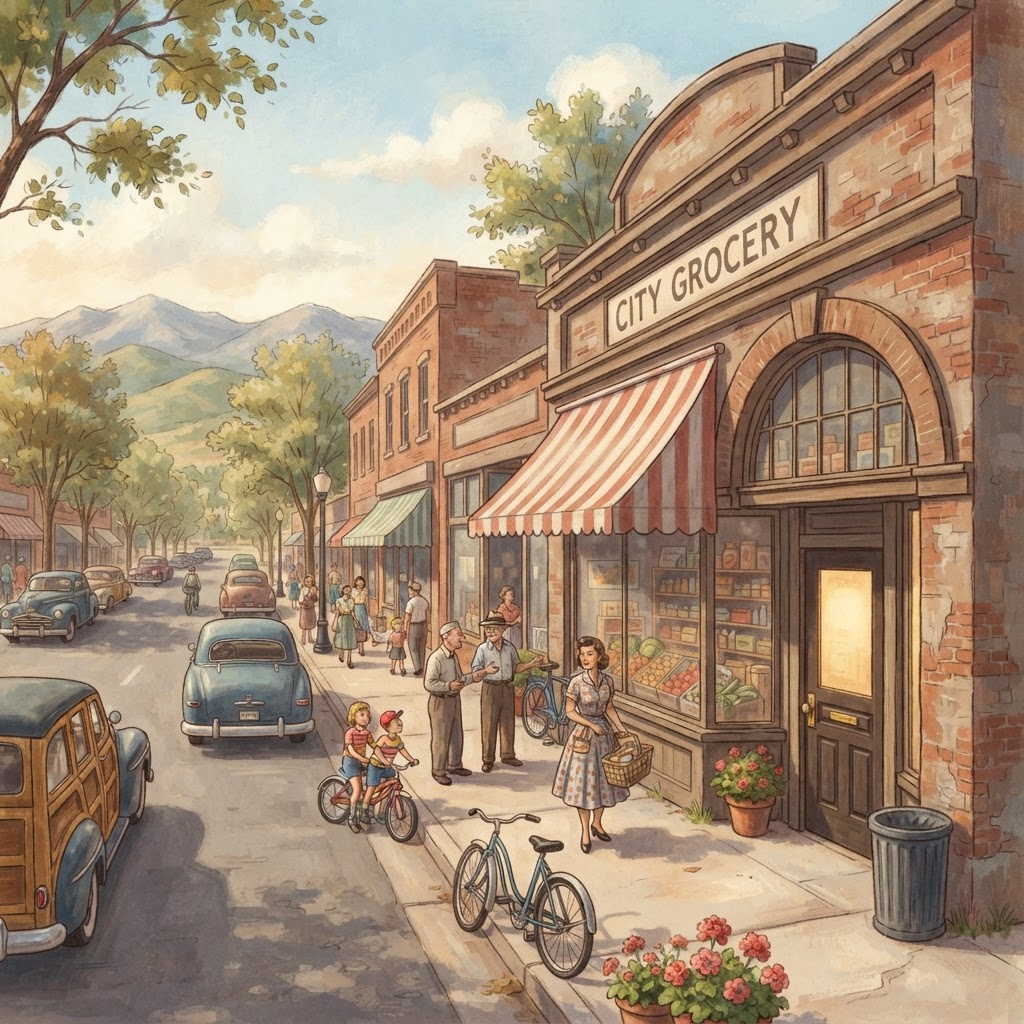
My Memories of Floyd’s Market
723 South Eighth Street
Rocky Ford, Colorado
By
Robert W. Saulmon
June, 2019
Photo 1

The east face of the store building in the early 1940’s. Leroy’s Market became Floyd’s Market in the late 1940’s.
BACKSTORY
I was born in Red Oak, Iowa on December 11, 1938 to Floyd and Ione Saulmon, joining 2 older sisters, Beverly and Jackie. My parents were married in Lamar, Colorado in 1931 and moved to Red Oak because jobs were scarce and Floyd had some family in Red Oak. He worked for a Ford Dealership as their night mechanic for $7 a week for a 7-day work-week. Early in 1942, Floyd received a job offer in Long Beach, California at a Lincoln Car Dealership and decided to accept the offer. So, in June, 1942, our family of 5 loaded into our car, probably a 1930’s Ford, and headed west. I still have a memory of being in the back seat with my sisters, along with a model airplane Daddy had made. The airplane didn’t survive and we threw it out along the way.
We drove to Rocky Ford because Floyd had a brother, Leroy, there who owned and operated a small neighborhood grocery store, Leroy’s Market. By that time, the United States had entered WWII and Leroy was drafted into the military. Floyd had a crippled leg, due to having polio as a child, and therefore was 4-F and unable to serve. So, it was decided that Leroy would leave the store for the military and Floyd would stay as manager of Leroy’s Market, forgetting about the job offer in California. Floyd had no experience running a grocery store, but quickly learned how to be successful, even teaching himself how to cut meat.
We moved into the house at 725 South Eighth Street, next to the store. My paternal grandparents, Mabel and Louis Saulmon were already living there, so we moved in with them. The house was owned by my Aunt and Uncle, Leroy and Thelma Saulmon, but was deeded to Floyd and Ione after the war, as payment for Floyd running the store for Leroy. My grandfather died in 1946, leaving my grandmother still living with us for several more years. Floyd and Leroy provided their mother with various houses around Rocky Ford until her death in the 1973.
A picture of a portion of the house, with the store in the background, is shown in Photos 2 and 3. My folks remodeled the house in 1950, which removed the old screened porch on the front of the house.
Even at 80 years of age, I have many memories of living next to the store and working in the store from 1942 to 1956, when I left home to attend Colorado State University in Fort Collins.
THE STORE BUILDING
As seen in Photo 1, the store was probably originally only about 20’-25’ wide. The store building was widened by about 10 feet to the south, into the driveway between the house and the store, in about 1948-1950. Inside, the store was crowded with display shelves, the checkout counter, the meat counter, etc.
Photo 2

Photo 2 is the interior of the store looking toward the meat counter. Uncle Ray Saulmon can be seen behind the counter on the left. Floyd is on the right. On the counter in the foreground, are 2 adding machines, the charge-account cabinet and the cash register. Other stocked shelves are in the background.
Photo 3

Photo 3 shows my sister, Jackie, in the store after hours, as indicated by the blinds pulled down on the front windows. The charge-account cabinet is on the right in the foreground. This cabinet had an arrangement of metal panels, each of which had probably 10 spring-loaded wire clips. Each clip held the individual charge account slips. See Photo for a picture of a similar metal panel.
Referring to Photo 3, the scales for weighing produce is behind Jackie. A portion of the refrigerated dairy case is to the left. Fresh produce is on the shelf to the left. Not visible in the picture, are the potato and onion bins that were under the windows.
We swept the floors in the store once a day and oiled the floorboards probably 3-4 times a year. These chores were always done after hours, which lengthened our workday.
STORE HOURS
The store was open from 7:00 a.m. to 6:00 p.m. Monday through Friday and from 7:00 a.m. to 9:00 p.m. (or later) on Saturdays. The longer day allowed the farmers and others to come and buy their week’s groceries after supper. Most people in those days worked 6 days a week, so Saturday evening might have been their only chance to shop. The store closed only after the last family had finished their shopping and socializing. Sunday was the only day my parents had to relax.
STORE EMPLOYEES
Several store employees stayed on when Floyd took over the management of the store. Louise Silvers was the inventory re-order person and long-time clerk. Other employees I recall were: Helen Heit, Ben Sprague, Jim Phythian, Ray Saulmon, Ed Jeffries, and Tommy Minjarez. During the war years, 1942-1945, mostly young women worked in the store, as the men were in the military. Uncle Ray Saulmon moved to Rocky Ford at the end of WWII, after serving in the Army Air Corps and worked for Daddy for several years. Of course, Floyd worked full-time in the store. Ione worked in the store as needed. My sisters and I also worked in the store after school and in the summers.
POTATO SACKING
At age 6, I was put to work weighing 10-lbs of potatoes into paper sacks from a 100-lb burlap (gunny) sack. We used an old platform scales for this. A 100-lb bag most generally contained somewhat more than 100 pounds and the desire was to sack more than 10 ten-pound sacks out of each 100-pound bag. I was taught early that this was PROFIT!
EGG CANDLING
There was a cellar behind the store, which provided a somewhat cool place to store fresh produce and eggs. In those days, local farmers supplied eggs to the store without the eggs being certified as to size or quality. We had to inspect each egg before selling it in the store. I spent many hours candling and grading eggs in that dark cellar. Candling eggs consisted of holding each egg up to a hole in the end of a round container, in which was a light bulb. The light shown through the eggshell and enabled you to determine whether the egg inside the shell was OK. Out of each dozen or so eggs, one egg would not pass inspection, due to either being rotten or fertilized, and was discarded.
FRESH PRODUCE
Fresh produce, like head lettuce, was shipped to the store in non-refrigerated trucks. A crate of produce was probably covered with ice when it was initially loaded on a truck, but the ice melted long before the crate arrived at our store. As a result, most of the head lettuce was slimy on the outside upon arrival. Each head was cleaned up by removing the outer several layers of leaves before it could be offered to our customers. Quite often, I did that chore. By the time I finished, the front of my apron was a mess.
CHICKENS
I also remember getting fresh chickens delivered to the store from local farmers. The chickens had been killed and gutted, but not picked. So, we would get a big pot of boiling water, dunk the chickens into the water and take off the feathers. I don’t know how sanitary this procedure was, but it was what we did. In time, we would buy chickens fully ready to sell from other suppliers.
CHECKOUT SYSTEM
In those days, the UPC system and computers did not exist. So, our method of checking out a customer’s purchases was quite basic. We handwrote each item and it’s price on a store pad and then would total the amount by using a manual adding machine. The machine printed on a paper tape each item amount and the total. The store pad had an original and a carbon copy. I don’t recall who received what pad copy, If they paid in cash. But, if their purchase was put on a charge account, the original was placed in the charge file system cabinet and the running total was forwarded to the front sheet. Many of the area farmers charged their groceries and paid the bill off after the harvest in the fall of each year. It was very tedious to write each item and price on the pad, which I’m sure tested the patience of the customers. Each purchase total was also rung up on an old cash register, which provided the total of all sales during each day, whether cash or charge. At the end of each day, when the doors were closed, usually after supper, Floyd would reconcile the day’s total cash sales against the cash in the register drawer. It was his intent to balance the cash to the penny.
STOCKING SHELVES AND MARKING PRICES
Due to the limited shelving and large variety of groceries for sale, it was a constant chore to keep the shelves fully stocked. I can remember walking around with a pad and pencil and jotting down the number of certain items required to refill the shelves. Then I would go to one of the storerooms, find those items and carry them to the shelves. Of course, no item came pre-priced, so the price had to be handwritten on each can of soup, box of cereal, pair of shoelaces, etc., etc. We used black grease pencils for many years to mark the price on items. We finally began to use a self-inked rubber stamp pad, which had revolving rubber bands of numbers and symbols, which enabled you to set a price and stamp a case of canned goods in short order.
MEAT
Floyd adopted the phrase “Meats That You Can Eat” as the store’s slogan. As he quickly learned the meat market end of the store, he took great pride in providing high quality meat products. We purchased much of our meat products from Stauffer’s Meat Packing Plant on East Maple Avenue in Rocky Ford. Stauffer’s also processed bacon, wieners and hams in the back of their grocery store at 306 South Main. I can still remember going there as a youngster with Floyd and watching the employees removing the skins from the wieners, slicing the bacon, etc. I can still smell the smoky aroma of that place. We also bought meat, delivered by truck, from Swift and other meat companies. The customers, especially women, would ask Floyd for suggestions as to what they should cook for supper. He was an excellent salesman and always managed to find some cut of meat to their liking.
The meat department area was rather small, but efficient. We had the refrigerated meat case, which defined the meat area. Customers would come to the front of the case and place their order. The meat case contained the usual pre-cut meat, hamburger, lunch meat loaves, chicken, cheese, etc. Besides the meat case, there were 2 heavy meat blocks, a meat band saw, scales, a hamburger grinder, a slicing machine, a large walk-in cooler and, of course, the usual assortment of sharp knives, cleavers and meat saws. We always had a layer of fresh sawdust on the floor in the meat area to absorb any grease that fell.
I learned some aspects of butchering when I was around 15. I remember cutting up lots of chickens, using a sharp knife and a cleaver. I also took the bones out of lots of hams and learned how to tie a “ham-tying” knot, which I still use to this day for various purposes. I put many pounds of meat and suet through the grinding machine to make hamburger.
In the early 1950’s, Floyd bought an electric rotisserie machine and roasted many chickens for sale. I guess he started a deli service and discovered that many people wanted the luxury of buying pre-cooked food. Ione would also cook boneless roasts on special order.
The walk-in meat cooler usually contained a beef quarter that was “aging.” After several weeks in the cooler, a growth of mold would appear on the outside of the carcass and the meat was then very tender when cooked. Of course, the aged meat was more expensive. PROFIT!
PHONE ORDERS AND HOME DELIVERY
For as long as I was associated with the store, 1942-1956, the store provided twice-a-day free home delivery of grocery orders that people would place by phone. We delivered at 10:00 each morning and at 2:00 each afternoon. The store phone was mounted on a column in the center of the store and there was a platform attached to the column, which held a tablet on which we would write the items the caller wanted delivered. It was rather tedious listening to some people trying to decide what they wanted. One interesting remembrance was if someone ordered an item we either did not have or were temporarily out of, Floyd would send someone to another store in town to try to get the item to include in the delivery. He believed in SERVICE above all else.
The employee in charge of the deliveries would check out a bag of cash and coins to take on the delivery route. In those days, people left their houses unlocked. If a person was not home when we arrived, we simply entered the backdoor of the house, carried the groceries to the kitchen, put the perishables in the refrigerator and left the rest on the table. Cash customers would leave money on the table and we would leave the change for the amount of the delivery. I suppose there were deliveries to some customers who charged their purchases, but mostly it was a cash delivery. The delivery man would then reconcile the cash in the money bag when he got back to the store. I can still remember my sense of maturing when I got my driver’s license and was allowed to make deliveries by myself.
My uncle was quoted as saying that if you encounter a scantily-clad woman when you deliver groceries, be a gentleman, bow and back out of the house. I always thought that was interesting until, on one delivery, I indeed did walk into a house where a young mother was ironing in her underwear on a hot day with her little kids playing around the room. It didn’t seem to bother her in the least, so I completed my delivery and left, backing out all the way.
SORTING POP BOTTLES
In the 1940’s and 1950’s, soda pop came in glass bottles. The empty glass bottles were returned to the store for some small refund. We had an area behind the store where the empty bottles were stored until the vender would come by and reclaim them, giving the store a credit for the empty bottles. The soda company would then wash the bottles and reuse them. Anyway, this bottle storage area often became a cluttered mess with bottles of various brands mixed together. My job was to periodically sort these bottles into like brands and organize the area.
There were many brands of soda pop in those days: Coca Cola, Pepsi Cola, 7-Up, Dr.Pepper, Nehi, RC Cola, Grapette, O-So Grape, Orange Crush, Dad’s Root beer, Hires Root Beer, Squirt, Nesbitt, Bubble Up, and others I can’t recall. Some company bottled certain flavors, like Lime-Rickey, in quart bottles. There was a Coca Cola bottling plant in Rocky Ford and the bottles were embossed with “Rocky Ford” on the bottom. There was a Dr. Pepper Bottling plant in Lamar.
THANKSGIVING TURKEYS
About three weeks before Thanksgiving, customers would place their orders for turkeys. We probably had a list for 100 turkeys or more, which was a major effort. The turkeys were purchased from the Turkey Plant in Cheraw and were all frozen. But, how did we have room for that many turkeys? During those years, it seems that the weather was colder in November than it is now. So, we stored all the turkeys in an unheated warehouse building that had been built behind the store. Each turkey was numbered, so we could get the right turkey for the right customer. Somehow, the turkeys remained frozen until they were purchased.
Photo 11

Sale flyer
STORE ITEMS IN OUR COLLECTION
Photo 12

Penny gumball vending machine
Picture 4

The south side of the store before the building was widened after the big snow in 1948. Note the kerosene tank and pump. Also note the milk cases stacked next to the door. See Picture of a milk case we have in our collection.
Picture 7

Floyd and Ione are shown on the right. Jim Phythian is in the middle. The two on the left are unidentified. A small chest-type freezer is visible at the lower right. As I recall, the freezer held ice cream bars, popsicles and probably ice cream. They are holding cartons of ice cream. The photo was probably taken in the late 1950’s or the early 1960’s.
Picture 8

Me, preparing to cut a piece of round steak, on one of the two meat blocks. Note the block scrapers in the holders on the side of the block.
Picture 9

Our 1948 Chevy delivery panel truck. The employee in the photo is unidentified.
Photo of the 1948 Leroy’s Market Chevy delivery van decorated for the Arkansas Valley Fair Parade. Year??


